Glenn Vancauwenberghe and Bastiaan van Loenen have co-authored a book chapter on the Emergence of Open Spatial Data Infrastructures in the book ‘User Centric E-Government: Challenges and Opportunities‘, edited by Saqib Saeed, T. Ramayah and Zaigham Mahmood. The book provides user studies and theories related to user-centered technology design processes for e-government projects. The book mainly discusses inherent issues of technology design implications, user experiences, and guidelines for technology appropriation. Ethnographic studies focusing on real life examples enable readers to understand the problems in an effective way. Furthermore, the theories and results presented in the book should help researchers and practitioners to handle these challenges in an efficient way.
On Thursday 21 September, KCOD researcher Glenn Vancauwenberghe participated in the ‘Smart ideas, smart solutions’ seminar organised by FLAGIS, the Flemish Association for Geographic Information Systems. The seminar brought together practitioners from the public and the private sector and researchers to discuss about the key challenges in the domain of geospatial information in Flanders.
Glenn Vancauwenberghe was moderator of two discussion sessions on the topic of open geospatial data. In these sessions, both providers and users of open geospatial data shared their views on the status of open data In Flanders. While the data providers mainly talked about barriers that still hinder them to make their data available, the users explained how open data already helped them in developing and providing services and products. Most participants in the discussion sessions agreed with the need for more collaboration in the open data ecosystem: collaboration among data providers at different administrative levels, but especially collaboration between data providers and data users. Other suggested approaches and instruments for improving the Flemish open data ecosystem were the definition of high value ‘local’ datasets and the use of quality labels to clearly indicate the quality of a particular dataset.
Several KCOD researchers presented their work during the INSPIRE Conference 2017 in Kehl (Germany) and Strasbourg (France). The conference aimed to contribute to the implementation of the European INSPIRE Directive by 2020 and demonstrate the potential of the European Spatial Data Infrastructure resulting from INSPIRE for the environment and the EU Digital society.
On Wednesday, MSc Geomatics student Kotryna Valeckaite presented the approach and first results of the ‘Map of Open SDI’, a project by the Knowledge Centre to assess the openness of national Spatial Data Infrastructures in Europe. The data used in this assessment have been collected by the 2017 MSc Geomatics students of TU Delft, as part of their work for the course ‘Geo-information Organisation and Legislation’. In her presentation, Kotryna revealed some of the main problems and weaknesses of current national SDIs in Europe from the perspective of the international non-expert user.
On September 4 2017, the Knowledge Centre Open Data organised the well attended workshop ‘Towards a Map of Open SDI/INSPIRE’ at the INSPIRE 2017 Conference in Kehl (Germany) and Strasbourg (France). In this workshop, several experts presented their view and experiences on Open SDI and a first prototype of the ‘Map of Open SDI in Europe’ was shown.
The ‘Map of Open SDI in Europe’ explores the openness of NSDI/INSPIRE implementation in Europe, covering three key dimensions of Open SDIs: the readiness, the data availability and accessibility, and the impact of open SDIs. In the discussion sessions on the different dimensions of Open SDIs new ideas and suggestions were provided that will be incorporated in guidelines on how to measure and assess the open SDI.
The ‘Map of Open SDI in Europe’, a project of the Knowledge Centre Open Data of Delft University of Technology, is developed to provide SDI decision makers, practitioners and researchers with a more comprehensive understanding of the openness of spatial data infrastructures in Europe. The Map covers three key dimensions of Open SDIs: readiness, implementation and impact. The map provides an overview of the status of Open SDIs in different European countries.
The ‘Map of Open SDI in Europe’, a project of the Knowledge Centre Open Data of Delft University of Technology, is developed to provide SDI decision makers, practitioners and researchers with a more comprehensive understanding of the openness of spatial data infrastructures in Europe. The Map covers three key dimensions of Open SDIs: readiness, implementation and impact. The map provides an overview of the status of Open SDIs in different European countries.
The Knowledge Centre organizes a 3-hour workshop on ‘The Map of Open SDI/INSPIRE” at the INSPIRE 2017 Conference in Kehl (Germany) and Strasbourg (France). In this workshop, which will be held on Monday 4 September 2017, a first prototype of the ‘Map of Open SDI in Europe’ will be presented, showing the results of a first exploration of the openness of NSDI/INSPIRE implementation in Europe.
The ‘Map of Open SDI in Europe’, a project of the Knowledge Centre Open Data of Delft University of Technology, is developed to provide SDI decision makers, practitioners and researchers with a more comprehensive understanding of the openness of spatial data infrastructures in Europe. The Map covers four key dimensions of Open SDIs: the readiness, the data availability and accessibility, the use of spatial data and the associated benefits. The map provides an overview of the actions and initiatives taken in different Member States to open their SDI to stakeholders outside the public sector. During the workshop, several brainstorm sessions will be organized on each of the key dimensions of Open SDIs. The aim of these brainstorm sessions is to develop guidelines on how to measure and assess each of the four dimensions and to explore good practices that could be added to the Map. The results of the workshops will be used to update and improve the Map of Open SDI in Europe, making it a highly relevant and practical tool that shows the status of Open SDIs in Europe and supports decision makers and practitioners in making their own SDI more open.
The EuroSDR workshop on Sustainable Open Data Business Models for NMCAs will be organized in Delft (the Netherlands) on 18 and 19 September 2017. The workshop will bring together the NMCAs to present and share their experiences of open data and discuss the research results with representatives of academia.
Issues that will discussed will be:
- What were the outcomes of the online survey of April 2017?
- Which funding models can be utilised by NMCAs and how sustainable are these?
- What have the effects of open data been on the operational costs of the NMCA?
- Which options do NMCAs have to their disposal to refinance their operational costs?
- Is the supply of open data living up to expectations?
- What are the non-financial challenges to implementing open data?
- Is there a future for a pan-European open data infrastructure?
When: 18 – 19 September 2017
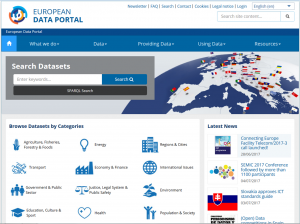
Heleen Vollers and Jorn Berends of the European Data Portal project visited the Knowledge Center Open Data on July 3rd. Together with a group of Geomatics students we discussed the need for data portals, the experiences of the students with data portals and reviewed the European Data Portal.
Bastiaan van Loenen presented research performed by the students in 2016. In their assessment on geoportals and open data portals most striking finding was the amount of broken links. Further most portals have a non-intuitive unique interface. Jorn Berends introduced and demo-d the European Data Portal.
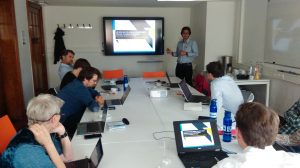
On June 30 PhD candidates of the Katholieke Universiteit Leuven and Delft University of Technology exchanged their PhD research concepts and ideas with each other in Leuven. Joep Crompvoets welcomed the Delft guest and introduced KU Leuven and the Public Governance Institute and Bastiaan van Loenen introduced the Knowledge Center Open Data. The PhD candidates that presented their research were:
- Maxim Chantillon: The Development of Public Policy Governance Models for Geospatial E-services, Characterized by a Focus on Public Sector Values
- Agung Indrajit: 4D Open SDI for Urban Participatory Spatial Planning Monitoring
- Stijn Wouters: The governance of e-government projects in Flanders
- Bujar Nushi: Assessing SDIs through stress testing
- Ine Buntinx: Governance mechanisms to support the use of innovative geospatial technologies for land tenure recording: case studies in East-Africa
- Frederika Welle Donker: Sustainable open data business models
- Roel Heijlen: (Big) data governance in the public sector
Next meeting wil be organised in the Summer of 2018 in Delft.